
Home / Income Tax Slabs
Income Tax Slabs Pakistan 2026-27: Salary Rates
The tax slab 2026-27 Pakistan salaried individuals now follow came into force on 1 July 2026 with the Finance Act 2026. The tax-free limit stays at Rs 600,000 a year, the slabs up to Rs 2.2 million are unchanged, and the four slabs above that carry lower rates. The surcharge on salaried income above Rs 10 million has been withdrawn. This page lists the salaried and non-salaried tables administered by the Federal Board of Revenue (FBR), with the monthly tax at each salary.
Tax is charged only on the part of your income inside each slab, not on the whole amount, which is where most mistakes start. A salary of Rs 250,000 a month pays Rs 23,000 a month, an effective rate of 9.2%, even though its top slab rate is 20%. The home page calculator returns the exact figure for any salary.
What Is an Income Tax Slab?
An income tax slab is a band of taxable income with its own rate. The income tax rate in Pakistan is progressive, so each rupee is taxed at the rate of the slab it falls in. Every slab above the first has a fixed amount, which is the tax already due on all income below that slab, plus a percentage of the excess.
FBR names the years by the calendar year in which they end. Tax year 2027 runs from 1 July 2026 to 30 June 2027, and is also written FY 2026-27. A table headed “Income Tax Slabs 2027” and one headed “2026-27” are the same table.
The fixed amount and the rate apply to taxable income, which is not the same as your gross salary. Exempt allowances and approved deductions come off first. If you only know your gross pay, treat the results as a close estimate.
Tax Slab 2026-27 Pakistan for Salaried Individuals
The Finance Act 2026 kept the first three slabs in the tax slab 2026-27 Pakistan salaried table and cut the rates on the next four. The new top slab starts at Rs 7 million instead of Rs 4.1 million, with a rate of 35%. The table below shows the whole structure for tax year 2027.
Taxable income (Rs a year) | Tax (Rs) |
|---|---|
Up to 600,000 | 0 |
600,001 to 1,200,000 | 1% of the excess over 600,000 |
1,200,001 to 2,200,000 | 6,000 + 11% of the excess over 1,200,000 |
2,200,001 to 3,200,000 | 116,000 + 20% of the excess over 2,200,000 |
3,200,001 to 4,100,000 | 316,000 + 25% of the excess over 3,200,000 |
4,100,001 to 5,600,000 | 541,000 + 29% of the excess over 4,100,000 |
5,600,001 to 7,000,000 | 976,000 + 32% of the excess over 5,600,000 |
Above 7,000,000 | 1,424,000 + 35% of the excess over 7,000,000 |
Use this table for any income earned from 1 July 2026. Crossing into a higher slab never cuts your take-home pay, because only the rupees above the line are taxed at the higher rate. To apply the table to your own pay, open the tax calculator and enter your monthly salary.
Tax-Free Limit in the Tax Slab 2026-27 Pakistan Table
The first Rs 600,000 of taxable income is taxed at 0%, which is Rs 50,000 a month. Someone earning exactly that amount pays nothing, and one rupee more in a year adds one paisa of tax. The limit is the same as in 2025-26, so nothing changes at the bottom of the salaried scale. The same table applies to men and women.
Who Uses the Salaried Table
The salaried table of the tax slab 2026-27 Pakistan applies when salary makes up at least 75% of your total taxable income. If you earn Rs 4 million from a job and Rs 500,000 from rent, salary is 89% of the total and the salaried slabs cover the whole amount. A person whose business or rental income is larger falls under the non-salaried table instead.
Tax Slab 2026-27 Pakistan for Non-Salaried Individuals and AOPs
The Finance Act 2026 did not change the rates for non-salaried individuals and associations of persons (AOPs). Business owners, freelancers, landlords and partnerships still use the table below. It starts at 15% above the Rs 600,000 limit, where the salaried table starts at 1%, and it reaches 45% at the top.
Taxable income (Rs a year) | Tax (Rs) |
|---|---|
Up to 600,000 | 0 |
600,001 to 1,200,000 | 15% of the excess over 600,000 |
1,200,001 to 1,600,000 | 90,000 + 20% of the excess over 1,200,000 |
1,600,001 to 3,200,000 | 170,000 + 30% of the excess over 1,600,000 |
3,200,001 to 5,600,000 | 650,000 + 40% of the excess over 3,200,000 |
Above 5,600,000 | 1,610,000 + 45% of the excess over 5,600,000 |
The gap between the two tax slab 2026-27 Pakistan tables is large. At Rs 2.4 million a year, a salaried person pays Rs 156,000 and a non-salaried person pays Rs 410,000. That difference is why the 75% test matters, and why freelancers with a contract and a payslip should check how their income is classified.
Professional Firms Under the Tax Slab 2026-27 Pakistan AOP Table
An AOP that is a professional firm barred from incorporating, such as a law or accounting partnership, pays a top rate of 40% instead of 45%. The lower slabs are the same as for any other AOP. A firm that does not qualify uses the standard AOP table.
Companies and Property Withholding
Companies are not taxed under either table of the tax slab 2026-27 Pakistan. A company pays corporate tax at its own First Schedule rate, so its profit does not use the AOP slabs. Withholding on property purchases and sales is also separate from slab tax. The FBR property tax calculator has the current rates.
Surcharge Above Rs 10 Million
Section 4AB adds a surcharge to the income tax of individuals and AOPs whose taxable income exceeds Rs 10 million. The Finance Act 2024 introduced it at 10%, and the Finance Act 2025 cut it to 9% for salaried individuals. The Finance Act 2026 withdrew it for salaried individuals altogether, so a salaried person earning Rs 12 million now pays slab tax only.
Non-salaried individuals and AOPs did not get the same relief, and the surcharge still applies to them above Rs 10 million. Check section 4AB for the rate before you rely on a figure. The surcharge is added to the slab tax and is not a separate slab, which is why no tax slab 2026-27 Pakistan table has a row for it.
Salary Tax in Pakistan Per Month
Your employer deducts one-twelfth of the annual slab tax each month, so Rs 100,000 a month attracts Rs 500 and Rs 500,000 a month attracts Rs 92,000. The table shows the monthly tax at the top of each 2026-27 slab and the effective rate. Salaries between two rows fall between the two tax figures.
Monthly salary (Rs) | Annual taxable income (Rs) | Monthly tax (Rs) | Effective rate |
|---|---|---|---|
50,000 | 600,000 | 0 | 0.00% |
100,000 | 1,200,000 | 500 | 0.50% |
183,333 | 2,200,000 | 9,667 | 5.27% |
266,667 | 3,200,000 | 26,333 | 9.88% |
341,667 | 4,100,000 | 45,083 | 13.20% |
466,667 | 5,600,000 | 81,333 | 17.43% |
583,333 | 7,000,000 | 118,667 | 20.34% |
Tax on salary in Pakistan is deducted by the employer under section 149. The employer estimates your annual taxable salary, works out the annual tax and spreads it over the months. A bonus is not taxed at a special rate: it is added to the year’s salary and taxed at whichever slab the total reaches. If you receive a bonus or an arrear, the estimate rises and the monthly deduction rises with it, and any shortfall is adjusted before the year ends.
Income Tax Slabs in Pakistan for Previous Years
The tables below give the salaried slabs for tax year 2026 (FY 2025-26) and tax year 2025 (FY 2024-25). They cover late returns and checks of past payslips. The 2025-26 table is the usual comparison with the current year.
Each table uses the same layout: a fixed amount plus a rate on the excess. FBR names the 2025-26 table tax year 2026 and the 2024-25 table tax year 2025. Pick the table by the year the income was earned, not the year you file.
Tax slab 2025-26 Pakistan (tax year 2026)
For income earned from 1 July 2025 to 30 June 2026, salaried individuals used a table with only six slabs. Everything above Rs 4.1 million was taxed at 35%, and a 9% surcharge applied above Rs 10 million. Under the salary tax slab 2025-26, a salary of Rs 12 million paid Rs 3,685,290 in total, slab tax plus surcharge.
Taxable income (Rs a year) | Tax (Rs) |
|---|---|
Up to 600,000 | 0 |
600,001 to 1,200,000 | 1% of the excess over 600,000 |
1,200,001 to 2,200,000 | 6,000 + 11% of the excess over 1,200,000 |
2,200,001 to 3,200,000 | 116,000 + 23% of the excess over 2,200,000 |
3,200,001 to 4,100,000 | 346,000 + 30% of the excess over 3,200,000 |
Above 4,100,000 | 616,000 + 35% of the excess over 4,100,000 |
Tax slab 2024-25 (tax year 2025)
The 2024-25 table taxed lower earners far more heavily than the years after it. A salary of Rs 1.2 million paid Rs 30,000 then and pays Rs 6,000 now. The Finance Act 2025 cut the rates on the first three taxable slabs.
Taxable income (Rs a year) | Tax (Rs) |
|---|---|
Up to 600,000 | 0 |
600,001 to 1,200,000 | 5% of the excess over 600,000 |
1,200,001 to 2,200,000 | 30,000 + 15% of the excess over 1,200,000 |
2,200,001 to 3,200,000 | 180,000 + 25% of the excess over 2,200,000 |
3,200,001 to 4,100,000 | 430,000 + 30% of the excess over 3,200,000 |
Above 4,100,000 | 700,000 + 35% of the excess over 4,100,000 |
Salary Tax Worked Examples for the Tax Slab 2026-27 Pakistan
The five examples apply the 2026-27 table to monthly salaries from Rs 100,000 to Rs 1 million. Each applies the 2026-27 table and assumes that gross pay equals taxable income, that salary is the only income and that no tax credit applies. The 2025-26 figure is shown beside each result so you can see who gained from the Finance Act.
To check an example by hand, take the slab’s fixed amount and add the rate on the excess over its floor. The code snippet below returns the same numbers. A wrong answer usually means the wrong year.
Example 1: Rs 100,000 a month
Annual taxable income is Rs 1,200,000, the top of the 1% slab. Tax is 1% of the Rs 600,000 above the limit, which is Rs 6,000 a year or Rs 500 a month. That is an effective rate of 0.5%, and the 2025-26 figure is identical.
Example 2: Rs 150,000 a month
Annual taxable income is Rs 1,800,000, which sits in the 11% slab. Tax is Rs 6,000 plus 11% of Rs 600,000, which is Rs 72,000 a year or Rs 6,000 a month, an effective rate of 4.00%. The 2025-26 tax was the same, so this salary did not gain from the budget.
Example 3: Rs 250,000 a month
Annual taxable income is Rs 3,000,000, in the 20% slab. Tax is Rs 116,000 plus 20% of Rs 800,000, which is Rs 276,000 a year or Rs 23,000 a month, an effective rate of 9.20%. Under the 2025-26 table the same salary paid Rs 300,000, so the saving is Rs 24,000 a year or Rs 2,000 a month.
This is the first salary level that gains from the new rates, because it is the first to reach the 23% slab that was cut to 20%. Anyone below Rs 183,334 a month paid the same tax in both years. Relief starts in the middle of the scale.
Example 4: Rs 500,000 a month
Annual taxable income is Rs 6,000,000, in the 32% slab. Tax is Rs 976,000 plus 32% of Rs 400,000, which is Rs 1,104,000 a year or Rs 92,000 a month, an effective rate of 18.40%. The same salary paid Rs 1,281,000 in 2025-26, so the saving is Rs 177,000 a year, about Rs 14,750 a month.
The effective rate is well below the 32% marginal rate. The saving grows quickly above Rs 4.1 million because several slabs were cut together. Each extra rupee of salary is still taxed at 32%.
Example 5: Rs 1,000,000 a month
Annual taxable income is Rs 12,000,000, in the top slab. Tax is Rs 1,424,000 plus 35% of Rs 5,000,000, which is Rs 3,174,000 a year or Rs 264,500 a month, an effective rate of 26.45%. In 2025-26 the slab tax was Rs 3,381,000 and the 9% surcharge added Rs 304,290, for a total of Rs 3,685,290.
The saving is Rs 511,290 a year, or about Rs 42,600 a month. Roughly 60% of it comes from removing the surcharge. The rest comes from the lower rates in the middle slabs.
Summary of the Five Tax Slab 2026-27 Pakistan Examples
Nothing changes up to Rs 150,000 a month, and the saving then grows with every step up. The last column is the annual saving a salaried taxpayer gets from the Finance Act 2026. Most of the Rs 511,290 saved at Rs 1 million a month is the withdrawn surcharge.
Monthly salary (Rs) | Annual tax 2026-27 (Rs) | Monthly tax (Rs) | Effective rate | Annual tax 2025-26 (Rs) | Saving a year (Rs) |
|---|---|---|---|---|---|
100,000 | 6,000 | 500 | 0.50% | 6,000 | 0 |
150,000 | 72,000 | 6,000 | 4.00% | 72,000 | 0 |
250,000 | 276,000 | 23,000 | 9.20% | 300,000 | 24,000 |
500,000 | 1,104,000 | 92,000 | 18.40% | 1,281,000 | 177,000 |
1,000,000 | 3,174,000 | 264,500 | 26.45% | 3,685,290 | 511,290 |
Code Snippets: Tax Slab 2026-27 Pakistan in JavaScript
Developers can reuse the function below to embed the slab logic. It stores each year’s slabs as data, finds the slab that contains the income and returns the tax, the monthly figure and the rates. It runs in the browser, so no salary data leaves the visitor’s device.
Keep the slab arrays in a separate file so that next year’s budget needs one data change and no code release. Both snippets were tested. The second snippet shows how to add the surcharge, which depends on the taxpayer type and the year.
// Slabs: [upperLimit, fixedTax, rateOnExcess]; lower limit is the previous upper limit
const SLABS = {
  "2026-27": { salaried: [[6e5,0,0],[1.2e6,0,.01],[2.2e6,6000,.11],[3.2e6,116000,.20],
                          [4.1e6,316000,.25],[5.6e6,541000,.29],[7e6,976000,.32],[Infinity,1424000,.35]] },
  "2025-26": { salaried: [[6e5,0,0],[1.2e6,0,.01],[2.2e6,6000,.11],[3.2e6,116000,.23],
                          [4.1e6,346000,.30],[Infinity,616000,.35]] },
  nonSalaried: [[6e5,0,0],[1.2e6,0,.15],[1.6e6,90000,.20],[3.2e6,170000,.30],
                [5.6e6,650000,.40],[Infinity,1610000,.45]],
};

function slabTax(annual, table) {
  if (!Number.isFinite(annual) || annual < 0) throw new RangeError("Enter taxable income of 0 or more");
  let lower = 0;
  for (const [upper, fixed, rate] of table) {
    if (annual <= upper) {
      const tax = fixed + rate * (annual - lower);
      return { tax, monthly: tax / 12, effective: annual ? tax / annual : 0, marginal: rate };
    }
    lower = upper;
  }
}

// slabTax(6e6, SLABS["2026-27"].salaried).tax   -> 1104000
// slabTax(6e6, SLABS["2025-26"].salaried).tax   -> 1281000
// slabTax(1.8e6, SLABS["2026-27"].salaried)     -> { tax: 72000, monthly: 6000, effective: 0.04, marginal: 0.11 }
// Surcharge (section 4AB): added to slab tax when taxable income exceeds Rs 10 million.
// Salaried: 9% in 2025-26, none from 2026-27. Non-salaried: confirm the rate in s.4AB before use.
const SURCHARGE = { "2026-27": { salaried: 0, nonSalaried: 0.10 }, "2025-26": { salaried: 0.09, nonSalaried: 0.10 } };
function totalTax(annual, year, type) {
const table = type === "salaried" ? SLABS[year].salaried : SLABS.nonSalaried;
const { tax } = slabTax(annual, table);
const surcharge = annual > 1e7 ? tax * SURCHARGE[year][type] : 0;
return tax + surcharge;
}
// totalTax(12e6, "2025-26", "salaried") -> 3685290Security and Privacy of a Tax Slab 2026-27 Pakistan Calculator
A safe slab calculator needs only an income figure. A page that asks for your CNIC, IRIS password or an OTP to show an estimate is not giving you one. Your return and tax credits belong on FBR’s IRIS portal, never in a message or third-party site. Treat any message that threatens a notice unless you click as a scam until you log in to IRIS yourself.
Check your payslip against the table before you file. If your employer’s deduction does not match the slab for your taxable income, ask payroll for the working. Keep the payslip and the deduction certificate, since both support your return.
For site owners, run the calculator client side and store no salary figures. Set a strict Content Security Policy and validate every input in code. Keep slab data in a versioned file so each result shows its year.
Common Tax Slab 2026-27 Pakistan Mistakes
The most common slab error is applying a slab’s rate to the whole income instead of the excess. The rest come from mixing the 2026-27 table with an older year or the wrong taxpayer type. The table below gives the fix for each.
Check the slab year first. A table that is one year out changes the tax on a Rs 500,000 salary by Rs 177,000. A wrong figure on a return can also trigger a notice.
Mistake | Why it is wrong | Correct approach |
|---|---|---|
Applying the top rate to the whole income | Only the part inside a slab is taxed at that slab’s rate | Use the fixed amount plus the rate on the excess over the slab floor |
Entering a monthly salary against annual slabs | The slabs are annual, so the tax comes out twelve times too small | Multiply by 12 first, then divide the tax by 12 |
Using gross pay as taxable income | Exempt allowances and deductions reduce taxable income | Start from taxable salary on the payslip or return |
Using the 2025-26 table for 2026-27 | The 2.2m to 7m slabs have new rates, so tax is overstated for higher earners | Use the table for the year in which the income was earned |
Using the non-salaried table for a salary | It starts at 15% and is far heavier than the salaried table | Salaried slabs apply when salary is at least 75% of taxable income |
Expecting the 9% surcharge on salary in 2026-27 | The Finance Act 2026 withdrew it for salaried individuals | Add the surcharge only for 2025-26 or earlier, or for non-salaried income |
Forgetting that a bonus is taxed as salary | It is added to the year’s income and can lift the slab | Add the bonus to annual salary before applying the table |
Tax Slab 2026-27 Pakistan vs 2025-26: What Changed
The Finance Act 2026 cut the rate in four slabs between Rs 2.2 million and Rs 7 million and split the old 35% slab into three. A salary of Rs 2.2 million or less pays the same as last year. The table sets each 2026-27 slab beside the rate that applied to the same income in 2025-26 and the annual tax at the top of the slab.
2026-27 slab (Rs a year) | Rate 2025-26 | Rate 2026-27 | Tax at slab top 2026-27 (Rs) | Tax at slab top 2025-26 (Rs) | Saving (Rs) |
|---|---|---|---|---|---|
Up to 600,000 | 0% | 0% | 0 | 0 | 0 |
600,001 to 1,200,000 | 1% | 1% | 6,000 | 6,000 | 0 |
1,200,001 to 2,200,000 | 11% | 11% | 116,000 | 116,000 | 0 |
2,200,001 to 3,200,000 | 23% | 20% | 316,000 | 346,000 | 30,000 |
3,200,001 to 4,100,000 | 30% | 25% | 541,000 | 616,000 | 75,000 |
4,100,001 to 5,600,000 | 35% | 29% | 976,000 | 1,141,000 | 165,000 |
5,600,001 to 7,000,000 | 35% | 32% | 1,424,000 | 1,631,000 | 207,000 |
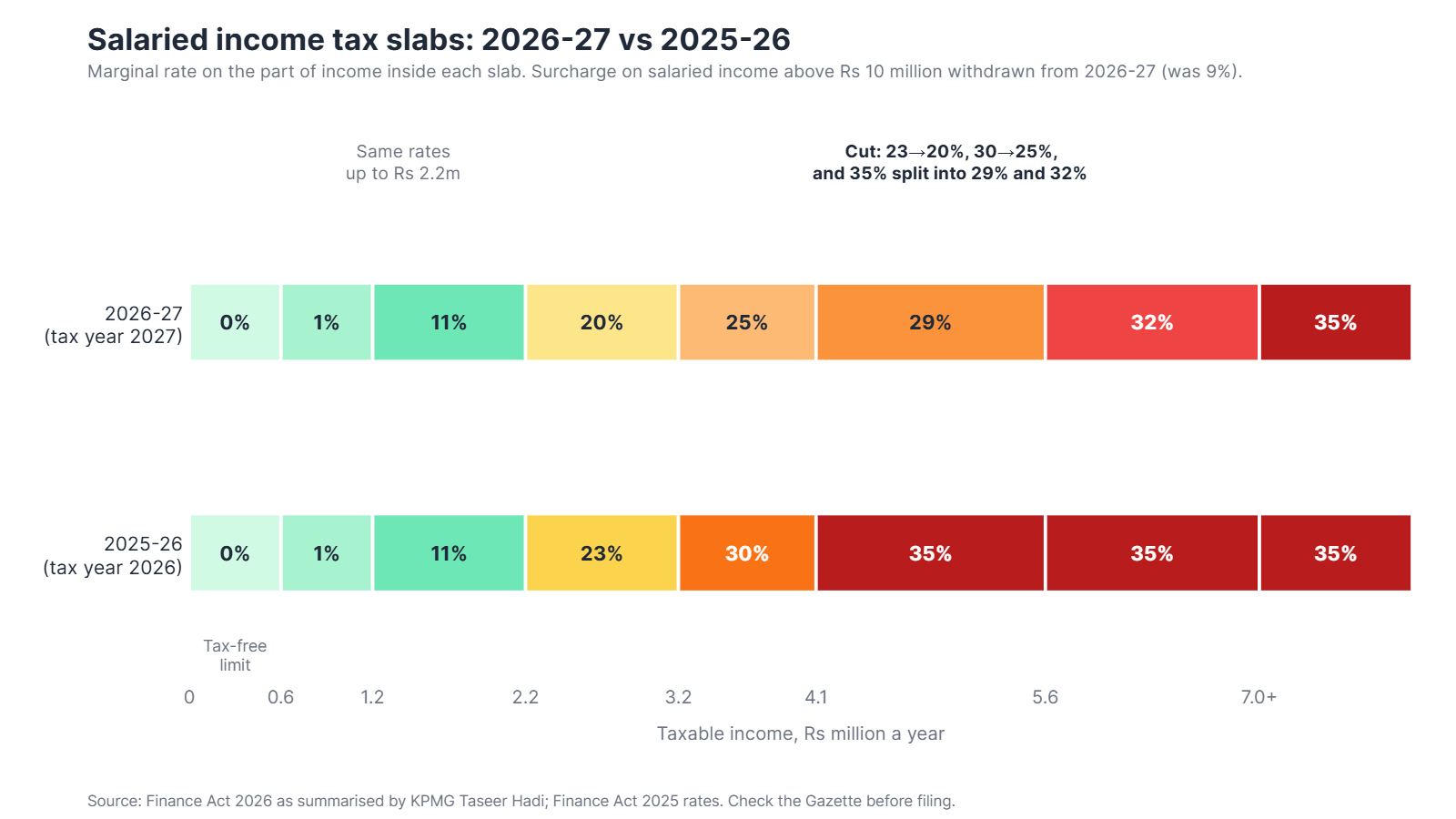
The savings are largest in the upper-middle slabs, so the benefit follows income. A taxpayer on Rs 5.6 million saves Rs 165,000 and one on Rs 7 million saves Rs 207,000, while a taxpayer on Rs 2.2 million saves nothing. Above Rs 7 million the slab tax saving stays at Rs 207,000, because the top rate is 35% in both years.
Salaried and non-salaried rates differ even more than the two years do. The table shows the 2026-27 tax at four incomes under each schedule. At Rs 8 million the non-salaried schedule costs Rs 916,000 more.
Annual taxable income (Rs) | Salaried (Rs) | Non-salaried or AOP (Rs) |
|---|---|---|
1,200,000 | 6,000 | 90,000 |
2,400,000 | 156,000 | 410,000 |
5,000,000 | 802,000 | 1,370,000 |
8,000,000 | 1,774,000 | 2,690,000 |
Tax Slab 2026-27 Pakistan FAQs
Answers use the Finance Act 2026 rates for tax year 2027 unless a question names another year. The figures assume that salary is the only income and that gross pay equals taxable income. The calculator on the home page gives the exact figure for your own income.
Conclusion
The tax slab 2026-27 Pakistan salaried taxpayers now use keeps the Rs 600,000 tax-free limit and the 1% and 11% slabs, cuts four upper slabs and drops the salaried surcharge. A Rs 150,000 salary pays the same Rs 6,000 a month as before, and a Rs 500,000 salary saves about Rs 14,750 a month. Non-salaried individuals and AOPs see no change at all.
Run your own figure through the home calculator for the exact monthly result. The page was last reviewed on 19 Oct 2026 against the Finance Act 2026. The tables are the first thing updated when the rates change.
Official sources
The rates on this page come from the Finance Act 2026 and the Income Tax Ordinance, 2001. Check them against the Gazette copy before you file. FBR’s notifications take precedence over any summary.